Sunday, 29 March 2015

Stashbusting; or, the 1790s waistcoat

Me trying to look dapper, and failing

The waistcoat

This project is a case of not actually historically accurate, but too good to pass up.  I got a fabulous blue and orange cotton last year at a sale, with a view to making a waistcoat out of it, and it's been sitting in my stash ever since.  Although the fabric isn't actually right for the 1790s, the bold colours and small diamond pattern are similar to some existing waistcoats from that time, and I think it looks good as a 1790s waistcoat.

Close up of the fabric
The nice thing about this fabric is that it is double-sided.  The reverse side provides an attractive colour contrast, which I've used for the pockets and lapels.

There were cotton waistcoats at this time, but I don't think any of them used fabric like this.  They were printed calico.  And you wouldn't have used a black lining either because period dyes would rub off on your shirt, but since this wasn't going to be a totally accurate project anyway I made some compromises, and one of these was using black lining because I preferred the look of it.  It contrasts nicely with the face fabric.  All the seams that don't show are machine seams, too.

The pattern comes from Norah Waugh's The Cut of Men's Clothes, page 80 (diagram XXIX).  I've used the pattern pretty much as is; I just added a couple of inches in the center back.  I know 18th century waistcoats were cut tight in the back, but there are limits.

Although I've seen plenty of these waistcoats on the internet, I've never seen one in person.  As a result I've had to guess about some parts of the construction, like how to do the pockets and the lining, and I've probably done a lot of things wrong.


The Challenge: Stashbusting.

Fabric: Half a meter of blue and orange cotton, and a bit under a meter of plain black calico.

Pattern: From Norah Waugh's The Cut of Men's Clothes, page 80.

Year: 1790s.

Notions: Thread buttons I made for the previous challenge and some silk thread for the hand-sewn parts.

How historically accurate is it?  Probably only about 40% - 50%.

Hours to complete: Around five.

First worn: For photos yesterday.

Total cost: About $18.50, including the cost of making the buttons.  The coloured cotton was $3/meter, and I'm pretty sure my mum gave me the black calico at some point in the fairly distant past.

Tuesday, 10 March 2015

Cooking with laser


The Historical Food Fortnightly Rare Ingredients challenge focuses on ingredients that are hard to obtain.  To me, this immediately suggested something made with silphium, or laser as it was called in Latin.  I can't use real silphium because it is extinct, but I can substitute asafoetida - which is itself a bit hard to get hold of in New Zealand (the secret to obtaining it is knowing that Indian grocers often use its Hindi name: hing).

In fact the ancients also used asafoetida in place of silphium.  It was already extinct by the time De Re Coquinaria was compiled, so the recipes that call for it would actually have been made with asafoetida.

Asafoetida comes from the same family as silphium and apparently tastes very similar, but it lacks the medicinal properties that made silphium so sought after.  It's not popular in Western cooking, apparently because people find the smell unpleasant.  I don't mind the smell myself, but I can see why some people dislike it.

I should mention at this point that I have a very poor sense of smell.

Anyway, today's historical recipe is Parthian Chicken, an Apicius recipe which may or may not resemble actual Parthian cooking.  Here is the recipe:

Pullum Parthicum: pullum aperies a navi et in quadrato ornas. teres piper, ligusticum, carei modicum. suffunde liquamen. vino temperas. componis in cumana pullum et condituram super pullum facies. laser [et] vivum in tepida dissolvis, et in pullum mittis simul, et coques. piper aspersum inferes.

Here it is in translation courtesy of the University of Chicago:

Dress the chicken carefully and quarter it. Crush pepper, lovage and a little carraway moistened with broth, and add wine to taste. After frying place the chicken in an earthen dish, pour the seasoning over it, add laser and wine. Let it assimilate with the seasoning and braise the chicken to a point. When done sprinkle with pepper and serve.

Note that this version translates liquamen as "broth".  This is not very accurate; liquamen is our old friend garum, the quintessential Roman flavour.  There are recipes out there for making your own garum/liquamen, but I use nuoc mam fish sauce which is pretty much the same thing.

Neil from Pass the Garum says you can substitute celery for lovage, which is good because in 21st century New Zealand lovage is even harder to find than asafoetida.

I used a chicken breast instead of a whole bird, because there's only one of me, and a Shingle Peak pinot noir.  I don't know how closely Marlborough pinot noir resembles your typical Roman wine.  I tend to find New Zealand wines have more tannin than Italian ones, but whether this was true of wines in the Roman period (or even all modern Italian wines) I can't say.  I imagine there were many varieties of wine available then, just as there are now.


The Challenge: Rare Ingredients.

The Recipe: Pullum Parthicum from De Re Coquinaria by Apicius.

The Date/Year and Region: Fourth century AD Rome.

How Did You Make It: As per the recipe, I braised my chicken in wine and spices, with a little fish sauce.  I cooked the chicken for 20 minutes, at 170 degrees C.

Time to Complete: Twenty minutes braising time, plus the time I took to sear the chicken.  This is a quick and easy recipe.

Total Cost: I already had most of the ingredients on hand, but had to buy some asafoetida/laser/hing and caraway seeds.  These cost $7.50, but there is plenty left over.

How Successful Was It? This dish is fantastic!  The flavours are subtle, but well balanced.  I now understand why the Romans were so keen on laser - it gives the meat a beautiful savoury taste.  The meat was juicy and tender, but then braised meats always are.

How Accurate Is It?  Of course, I used modern kitchen equipment.  I also used celery instead of lovage, but otherwise I think this is reasonably accurate.  Even using celery isn't totally outside the realms of possibility for a Roman cook.  Every cook has to make do sometimes, no matter what time period they live in.

Tuesday, 10 February 2015

This year's big nerdy project

This is 20 meters of linen.


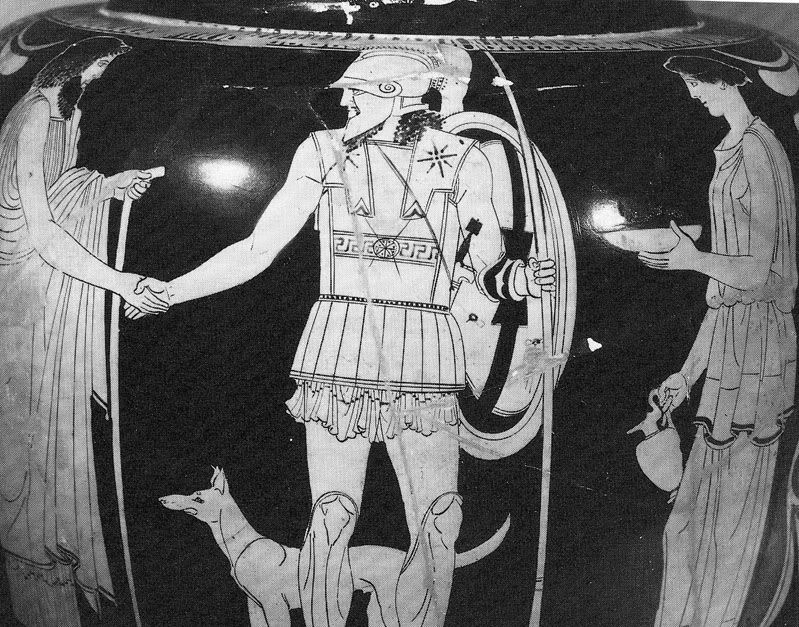
It's all intended for April's Historical Sew Monthly project, which I'm quite excited about. I'm going to make a linothorax.  If you're unfamiliar with this term*, the linothorax was a piece of body armour made of linen, which was used by the ancient Greeks and Etruscans.

The recent book by Gregory Aldrete, Scott Bartell, and Alicia Aldrete focuses on linen armour as used by Alexander the Great's army, and as you would hope it contains instructions and a pattern for the reader who wishes to make their own at home.  The authors have used research and practical experimentation to determine how linen armour might have been made, and whether it could have provided reasonable protection in battle.  It appears the linothorax worked a bit like kevlar in that it absorbed and dissipated the force of a blow, and it offered pretty good protection against the weaponry of the time.

Here's a picture of a chap wearing a linothorax:

hoplitedeparting450.jpg
Image found here.

If, like me, you have a Classics degree, you know that armour like this is pictured a lot in Greek art, which implies it was quite common.

Predictably, I bought the linen before I got to the part of the book that describes how much linen is required, and probably bought a lot more than I will actually need, but linen isn't cheap and I had to take advantage of The Fabric Warehouse's 40% off sale while it was on.  Yes, I could possibly have got the linen cheaper online somewhere, but with the Fabric Warehouse I know what I'm getting.  For one thing I know it is linen, and not some dodgy mystery blend.  It'll still have slightly different properties to ancient Greek linen, because it has been produced using modern industrial methods, but it's the closest I'm going to get on my budget.  It's is a medium-weight linen which is, I suspect, a reasonable approximation of what the ancient Greeks might have used.


*Strictly speaking, "linothorax" is an Anglicised version of the Greek term λίνος θώραξ  .

Tuesday, 3 February 2015

Dorset buttons


Making thread buttons is a new skill for me, and I think they came out quite well.  These are a very simple design, of course, but I like them.  They remind me of Fortuna's Wheel, which in turn reminds me of A Confederacy of Dunces, and that makes me laugh.  And they are the same colour as the TARDIS.

I remember reading somewhere that thread buttons were the most common type of button used on 18th century outfits, but of course I've now forgotten where I read that.

My buttons are copies of an original example found here, and are quite simple to make.  They involve covering a metal ring (in this case a curtain tie-back ring) with thread using buttonhole stitch, then weaving a little pattern in the center of the ring.  I stuck to a simple design, but thread buttons could be incredibly elaborate like the ones shown here.

The Challenge: Blue.

Fabric: N/A.

Pattern: Copied from a picture.

Year: 18th century to early 19th century.

Notions: TARDIS-blue cotton embroidery thread and metal curtain tie-back rings.

How historically accurate is it?  Not really.  My construction technique is accurate, but the originals would have been made of linen or silk, not cotton, and the rings would have been brass.  Maybe 70% at best.

Hours to complete: Between 20 and 30 minutes for each button.  Apparently, some Dorset button makers could get through six or seven dozen buttons per day.

First worn: Not yet.  They have been put in my stash in anticipation of next month's challenge.

Total cost: About $17 all up.

Friday, 30 January 2015

Apicius' medicinal salts


This fortnight's historical food theme is Descriptive Foods.  Apicius' sales conditos ad multa  or "salts for many ailments" are more of a condiment than a food as such, but they have such a wonderfully descriptive name.  Apicius tells us this spicy salt mixture fights indigestion and colds, as well as all kinds of other illnesses.  And it keeps you regular.

The recipe says:

Sales conditos ad digestionem, ad ventrem movendum, et omnes morbos et pestilentiam et omnia frigora prohibent generari, sunt autem et suavissimi ultra quam speras. sales communes frictos lib. I, sales ammonicos frictos lib. II, piperis albi unc. III, gingiber unc. II, ammeos unc. I semis, thymi unc. I semis, apii seminis unc. I semis (si apii semen mittere nolueris, petroselini mittis unc. III), origani unc. III, erucae semen unc. I semis, piperis nigri unc. III, croci unc. I, hysopi Cretici unc. II, folium unc. II, petroselinum unc. II, anethi unc. II.

Here's a translation from the University of Chicago's website:

These spiced salts are used against indigestion, to move the bowels, against all illness, against pestilence as well as for the prevention of colds. They are very gentle indeed and more healthy than you would expect. Make them in this manner: 1 lb. of common salt ground, 2 lbs. of ammoniac salt, ground, 3 ounces white pepper, 2 ounces ginger, 1 ounce of Aminean bryony, 1 of thyme seed and 1 of celery seed . If you don't want to use celery seed take instead 3 ounces of parsley seed, 3 ounces of origany, 1 ounce of saffron, rocket, 3 ounces of black pepper, 1½ ounces rocket seed, 2 ounces of marjoram, Cretan hyssop, 2 ounces of nard leaves, 2 ounces of parsley seed and 2 ounces of anise seed.

Readers who speak Latin will notice the translation doesn't quite line up with the Latin text, as it has been put together from several sources.  I'm going off the Latin, and thus I get the following recipe:

1 pound salt
2 pounds ammoniac salt
3 ounces white pepper
2 ounces ginger
1 ounce God only knows (see below)
1 ounce thyme
1 ounce celery seed
3 ounces oregano
1 1/2 ounces rocket seed
3 ounces black pepper
1 ounce saffron
2 ounces Cretan hyssop (which likely means marjoram)
2 ounces cassia (see below)
2 ounces parsley seeds
2 ounces anise seeds

Ingredients and substitutions

I quickly discovered just how hard it is to be to get hold of some of the ingredients in this recipe, but I soldiered on anyway because I'm stubborn.  I couldn't get rocket seeds or bryony at all.  However, I found a different translation of this recipe that translates ammeos not as "Aminean bryony", but as "cumin".  I don't know why they say cumin, which is cuminum in Latin, but so far as I know bryony is bryonia so I have no clue what's going on here.

Nard is an interesting one.  There is a school of thought that says the plant known to the ancient world as nard was actually lavender.  See, for instance, Victoria Rumble's book Soup Through the Ages: A Culinary History with Period Recipes.  However, authorities such as Francis Adams say that Apicius' word folium means cassia.  Nard, whatever plant it came from, is spica nardi in Latin, so I'm inclined to think nard could be a mistranslation in this case.

The recipe suggests that the celery seeds and parsley seeds can be used interchangeably, so I used celery seeds only.  I like celery seeds and they are easier to get.

Another ingredient I couldn't get hold of was the ammoniac salt, but I'm not sure I want it anyway.  Ammoniac salt (better known to chemists as ammonium chloride) has some medicinal properties and is sometimes used in food as well, but only in very small quantities.  In large doses it is toxic.  I decided to forget about it and use regular salt instead.

Making the salts

The Roman ounce was a bit smaller than ours, and there were 12 of them in the pound.  I scaled down the ingredient quantities significantly seeing that I didn't really know what the result would be like, so where the recipe says an ounce I used a quarter teaspoon.  After that it was simply a case of mixing everything together.


The Challenge: Descriptive Foods.

The Recipe: Sales conditos ad multa from De Re Coquinaria by Apicius.

The Date/Year and Region: Fourth century AD Rome.

How Did You Make It: As described above.

Time to Complete: Just a few minutes.

Total Cost: I already most of the ingredients on hand.  I bought the rest from www.nutsandspices.co.nz , a retailer I highly recommend if you're in New Zealand.  This cost $15, but I have plenty of the ingrdients left over for other recipes.

How Successful Was It? Honestly, I'm really skeptical of the recipe's ability to combat disease.  Yes, herbs can have medicinal properties, but I doubt sprinkling some on your dinner is going to achieve very much.  I suspect this stuff relied heavily on the placebo effect.  But more importantly, was it tasty?

Yes, it was.  The mixture has a distinct smell of aniseed and I wasn't sure aniseed salt would taste good, but as it turned out I couldn't really taste the aniseed.  It's basically a savoury herb salt similar to celery salt, but with subtle spicy notes.  It would probably work well in any context where you would normally use celery salt.

How Accurate Is It?  Between the ingredients I couldn't get and the fact that I actually left out the primary ingredient on the grounds that it is poisonous, not very.

Wednesday, 14 January 2015

Foundations


When historical costuming people talk about foundation garments they usually mean women's garments such as corsets, but a gentleman's outfit needs appropriate foundations too.  Especially in the 18th century when a clean shirt was also the foundation of a gentleman's personal hygiene routine.

I want to make a 1790s waistcoat for one of the challenges this year, so I'm taking this opportunity to make a shirt to go with it.  I have actually tried one of these things before, but *ahem* it didn't work out very well and got abandoned halfway through.  This shirt was a lot more successful.

Here is an interesting look at an existing shirt from the 18th century, and I've referred to this description while making my shirt.  As a result, I've used very narrow seam allowances (about a quarter inch in most cases) and I found this worked really well.  The resulting flat felled seams are very neat and tidy, and I don't think that would have been the case if they were wider.


My thread buttons are shamelessly copied from buttons made by The Victorian Tailor.

The Challenge: Foundations.

Fabric: 1.5 meters of lightweight linen.

Pattern: Diagram XXXII from Norah Waugh's The Cut of Men's Clothes: 1600 - 1900.

Year: Anywhere from the late 17th to the early 19th century.

Notions: Linen thread, including buttons made from linen thread.

How historically accurate is it?  Maybe 85% to 90%.  I suspect period linen was more like airplane linen* and mine is not that fine, but there was probably a certain amount of variation in the quality of period linen.

Hours to complete: Okay, let's see... 15 episodes of Stargate Universe at 45 minutes each = 11.25 hours.  Yikes.  I'm really slow.

First worn: Not yet.

Total cost: Somewhere around $15 maybe?  I honestly can't remember how much I paid for the linen.


* My grandfather was in the Airforce during WWII and my mum still has a few articles made from airplane linen that my grandfather acquired.  Like many Airforce wives, my grandmother also had a lot of underwear made from parachute silk.

Sunday, 11 January 2015

Some thoughts for 2015

Happy New Year, readers!

This year the Historical Sew Fortnightly has become the Historical Sew Monthly.  It had become unmanageable for our hostess Leimomi, and to be honest I think a project every two weeks is a bit much for most people.  Certainly it was never achievable for me. 

This year, unlike either of the last two years, I’ve put some thought into my HSM projects in advance and I already have ideas for most of the challenges.  They are just ideas at this stage and some of them will probably change over time.

      January – Foundations: make something that is the foundation of a period outfit.

A shirt.  An easy choice, but more of a challenge than it looks.  I’ve tried this pattern once before, and it was not a success.  Will it go any better the second time round?  We’ll find out.

      February – Colour Challenge Blue: Make an item that features blue, in any shade from azure to zaffre.

Blue is one of my favourite colours and I have a couple of blue items in mind for this year, but at this stage I think I would like to learn how to make Dorset buttons, to go with my item for the March challenge...

      March – Stashbusting: Make something using only fabric, patterns, trims & notions that you already have in stash.

I have a meter of blue and orange fabric that I think really ought to be a 1790s waistcoat.  It’s not period at all (it’s synthetic), but boy is it cool.  And I have a great pattern to use, too.  It's double breasted, which is why making the buttons could be a challenge all to itself.

      April – War & Peace: the extremes of conflict and long periods of peacetime both influence what people wear.  Make something that shows the effects of war, or of extended peace.

I'd really like to make a linothorax.  The guys who reconstructed the linothorax described in the previous link have a book out where they describe their research and how they made the armour.  I'd like to give it a try myself.

      May – Practicality:  Fancy party frocks are all very well, but everyone, even princesses, sometimes needs a practical garment that you can DO things in.  Create the jeans-and-T-Shirt-get-the-house-clean-and-garden-sorted outfit of your chosen period.

Last year I drafted a 15th century dress.  It’s not on the blog because I didn’t have the blog when I made it, but long story short it was made of synthetic fabric and fully machine sewn (because why bother spending all that time hand sewing something made of synthetic fabric).  Now I want to remake the dress properly in a period fabric using period techniques.  I've got some nice blue wool to make it in.

      June – Out of Your Comfort Zone: Create a garment from a time period you haven’t done before, or that uses a new skill or technique that you’ve never tried before. 

I have Janet Arnold’s pattern for the Shrewsbury Mantua, which would be a great option for this challenge, but I have other ideas as well so we’ll see what happens.

      July – Accessorize: The final touch of the right accessory creates the perfect period look.  Bring an outfit together by creating an accessory to go with your historical wardrobe.

I’ve got some dentalium shells on order, and I want to make a headband like this one:


Image found here.  Do check the site out, it is fascinating.

      August – Heirlooms & Heritage: Re-create a garment one of your ancestors wore or would have worn, or use an heirloom sewing supply to create a new heirloom to pass down to the next generations.

Probably something from Bronze Age or Viking Age Europe.  I must look to see whether there are any archaeological finds from around Møn (where my family lived before moving to New Zealand) that I can do something with.

      September – Colour Challenge Brown: it’s not the most exciting colour by modern standards, but brown has been one of the most common, and popular, colours throughout history. Make something brown.

Actually, I like brown.  For this challenge, I think I’ll revisit my side-pleated skirt pattern.  There are some improvements I want to try and brown is a feasible colour for this garment.

      October – Sewing Secrets: Hide something in your sewing, whether it is an almost invisible mend, a secret pocket, a false fastening or front, or a concealed message (such as a political or moral allegiance).

No idea.  No idea at all.

      November – Silver Screen: Be inspired by period fashions as shown onscreen (film or TV), and recreate your favourite historical costume as a historically accurate period piece.

Let’s face it, there are a lot of options here.  Overall, I think I would like to try something Egyptian, inspired by Theda Bara in the 1917 film Cleopatra.  I have a bit of a soft spot for Theda Bara, partly because my grandmother was named after her.  Mostly, however, I want an excuse to make a beaded dress.

      December – Re-Do:  It’s the last challenge of the year, so let’s keep things simple by re-doing any of the previous 11 challenges.

Maybe a pair of greaves to go with the linothorax?